
Category: News
-

New preprint: latent-entropy anomaly detection
In collaboration with ECE colleagues, we have put out a new variant of our unsupervised anomaly detection pipeline. This one uses a latent entropy loss to scramble the latent space, making anomalies harder to reconstruct (and hence easier to detect). No supervision (including a normal-only dataset) needed! Citation:
-

Ivan presents LLM confidence calibration at Shonan
—
Ivan had the honor of attending an invitation-only visionary workshop #235 on LLM-guided assurance and synthesis for CPS in Shonan, Japan. He presented the lab’s work on calibrating chain-of-thought confidence by discovering temporal patterns with Signal Temporal Logic. Materials: Some of the prominent debates at the workshop included:
-

Ivan named Malachowsky Family Endowed Rising Star
Big thanks to the Malachowsky Family for supporting our AI research! Also, congratulations to Alina and Yingying. Onwards! Links:
-
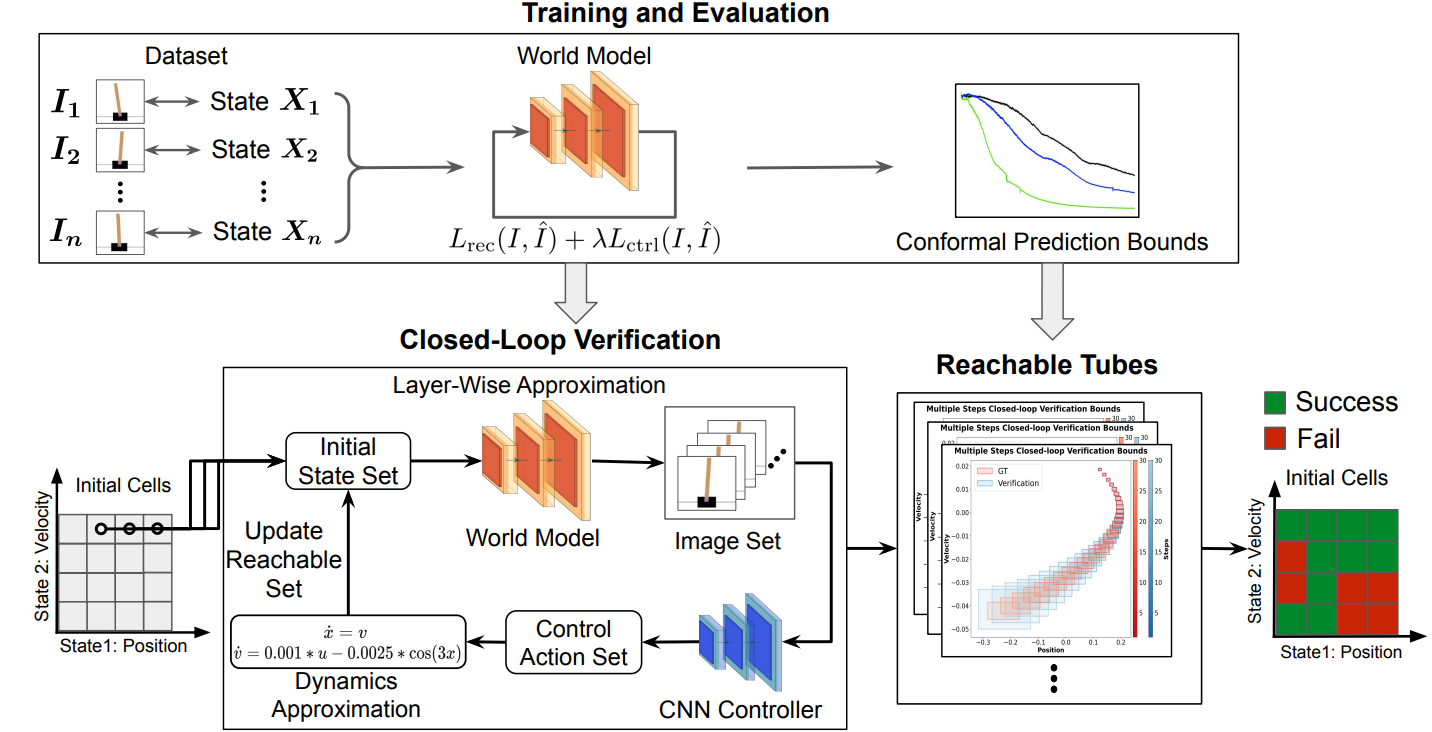
New preprint: verifiable deterministic world models
Our exploration of world models for system assurance resulted in a semi-predictable but currently unfashionable choice: removing randomness and uncertainty from the latent space made world models more verifiable (although a tiny bit less picture-perfect). More surprisingly, this step made the behaviors produced by them more relevant to the real world. As a result, we…
-

STL CoT confidence = most innovative poster
—
Zhenjiang and Ani presented a poster with their work on chain-of-thought confidence with signal temporal logic at the Annual Nelms IoT Conference. The core idea of this research is to find patterns in LLM confidence that tend to correlate with correct and incorrect answers. Then, these patterns can be used to determine the confidence, i.e.,…
-

New preprint: statistical-symbolic verification of perception
Our collaboration with RPI has yielded an extended and improved version of our NeuS’25 paper: combining conformal prediction for neural perception with reachability analysis for the dynamics and control. This problem required constructing a discrete abstraction of the perception neural net, which we did with a genetic algorithm. Citation:
-

ECE showcases new club: Gator Autonomous Racing
This semester marks a major development: the Gator Autonomous Racing (GAR) student club/design team was officially spun off from the TEA Lab. This week, the club has put together an impressive showcase with two racing cars (F1/tenth, aka RoboRacer) in the middle of Malachowsky Hall. The demonstration has attracted a lot of attention! A huge…
-

New preprint: a survey of CPS assumptions
We’ve put in a big effort to find, categorize, and analyze assumptions and guarantees in papers on cyber-physical systems since 2014. Now we’re happy to release the results! Citation: We are also sharing our database of analyzed papers and assumptions.
-

Ivan does publicity for a neuro-symbolic conference
—
Ivan Ruchkin is serving as the publicity chair of the 3rd International Conference on Neuro-Symbolic Systems (NeuS) 2026. Looking forward to your submissions!
-

Jordan presents V&V for vision-based systems at ATVA
—
Jordan Peper went all the way to Bengaluru, India, to present our work (in collaboration with UIUC) on unified verification and validation of vision-based autonomy at the International Symposium on Automated Technology for Verification and Analysis (ATVA). Allegedly, this is a hot problem, but the abstraction is quite complex. That’s what it takes — for…