
Category: News
-
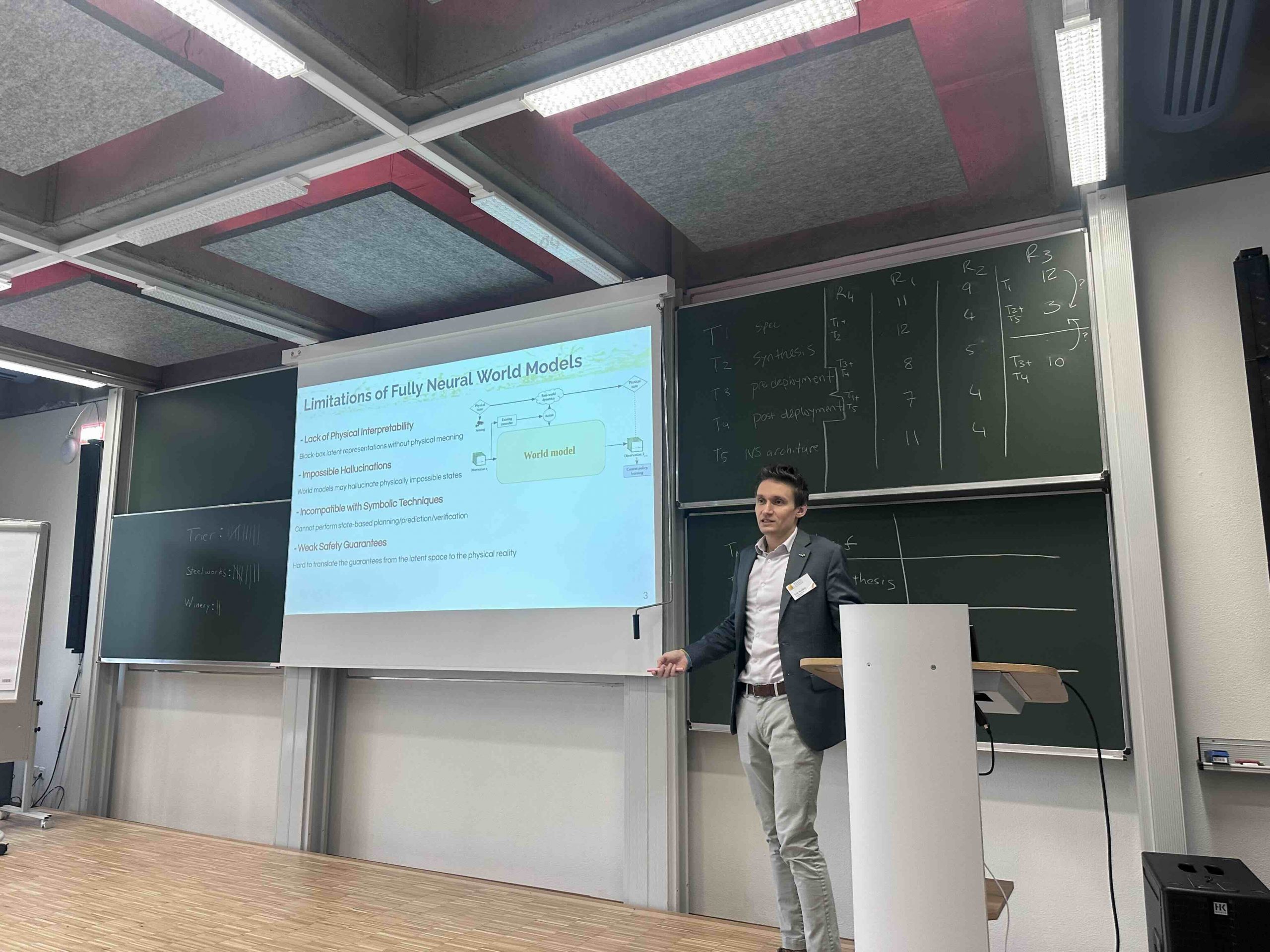
Ivan presents world model challenges at his first Dagstuhl
—
Ivan Ruchkin traveled to Germany for his first Dagstuhl Seminar, #26421 Advancing Testability and Verifiability of CPS with Neurosymbolic and Large Language Models. He gave an overview of world models and presented open research directions in physically interpretable world models. The open problems highlighted by Ivan’s talk:
-

Jordan gives an abstraction tutorial at ESWEEK
—
Jordan Peper traveled to sunny (?) Barcelona from sunny (?) Gainesville to educate the attendees of Embedded Systems Week 2026 on creating a conservative discrete-state system out of a continuous-state one. A 3-hour tutorial including the typical pitfalls that lead to the loss of soundness. The presentation allegedly elicited some really good questions.
-
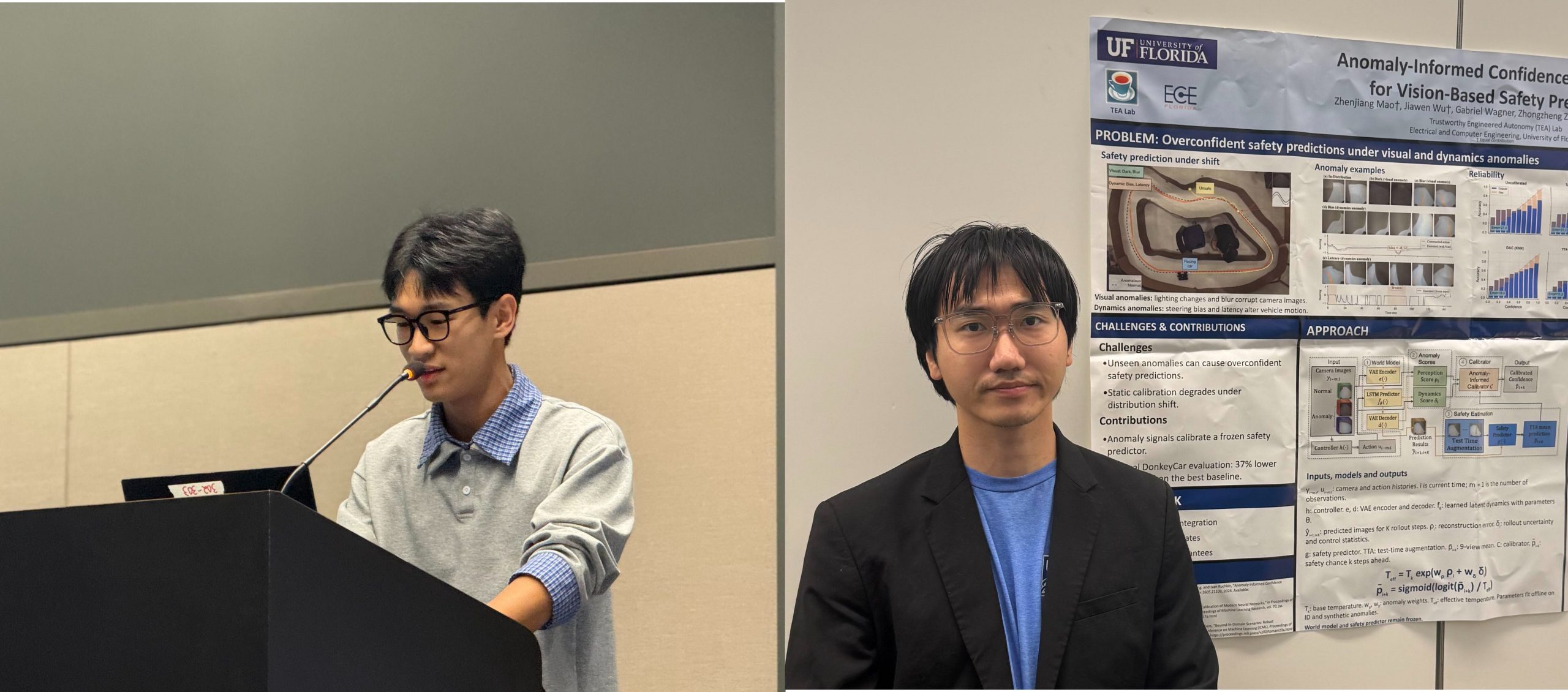
Yuang and Zhenjiang present anomaly research @ IROS
—
Yuang Geng and Zhenjiang Mao went to the IEEE/RSJ International Conference on Intelligent Robots and Systems (IROS) in Pittsburgh, PA, to present our lab’s work on mitigating anomalies in imitation learning and trajectory prediction. They went to represent UF as part of a bigger Gator robotics crowd. Presented papers:
-
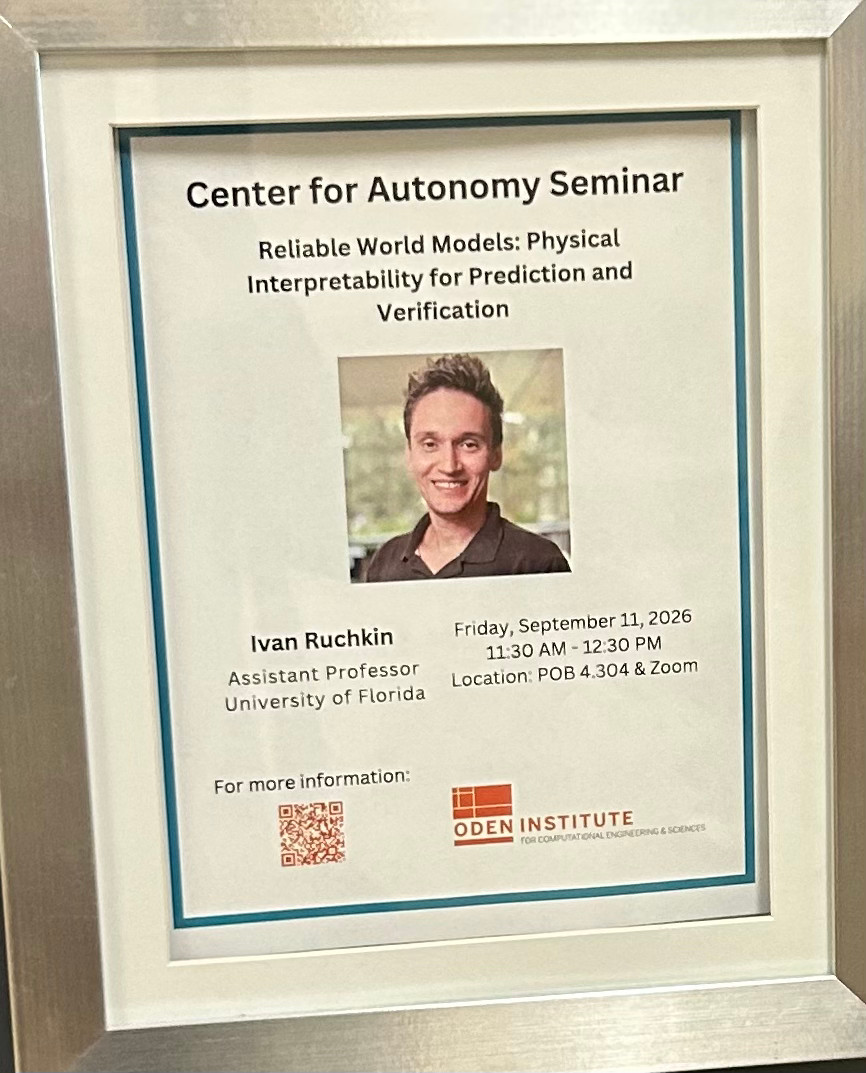
Ivan talks about world models at UT Austin
Ivan visited Ufuk Topcu, the Center for Autonomy, and the Oden Institute at UT Austin with a talk about physically interpretable world models. The discussions included whether anyone has mounted a camera on an inverted pendulum and whether robotics is all about “getting it to work”. The following papers were featured in the talk:
-

GAR wins 3rd place at vehicle conference in Boston
—
A team of our friends from the Gator Autonomous Racing (GAR) club went to Boston for the Vehicular Technology Conference (VTC) and took third place! That was the first in-person competition for the club. Congratulations, and wishing GAR many more such performances!
-
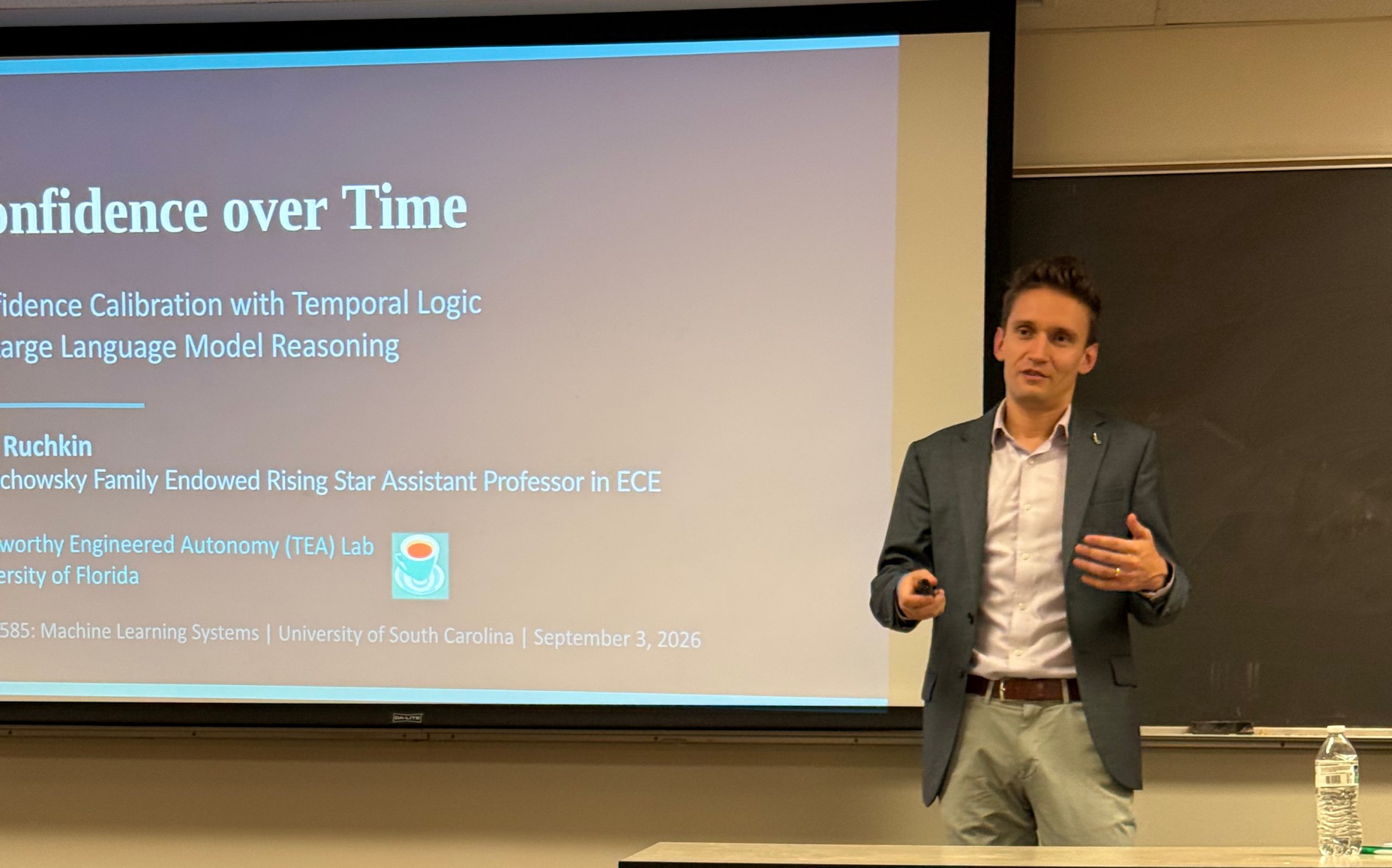
Ivan visits South Carolina with confidence and robustness
Ivan visited Pooyan Jamshidi at the University of South Carolina. The agenda included conversations with like-minded researchers and tours of impressive mechanical, industrial, and electrical facilities. Thanks to UF and the SEC for supporting this academic exchange! In addition, Ivan gave two talks about the recent research on confidence and robustness:
-
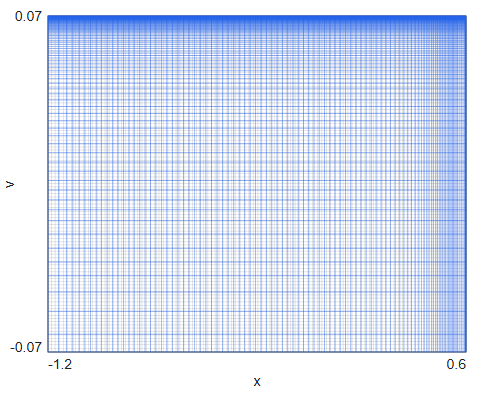
New preprint: differentiable discrete abstractions
Our team figured out how to optimize discrete abstractions of continuous-state systems with gradient descent. The solution lies in a smooth proxy for a simulation metric. An example state grid, resulting from our technique, is shown above. Details below:
-

New tutorial: conservative discrete abstractions
Our tutorial on building conservative, sound discretizations of continuous-state systems is finally online! To be presented by Jordan at the Embedded Systems Week in Barcelona. Citation:
-
Zhenjiang defends his PhD thesis proposal
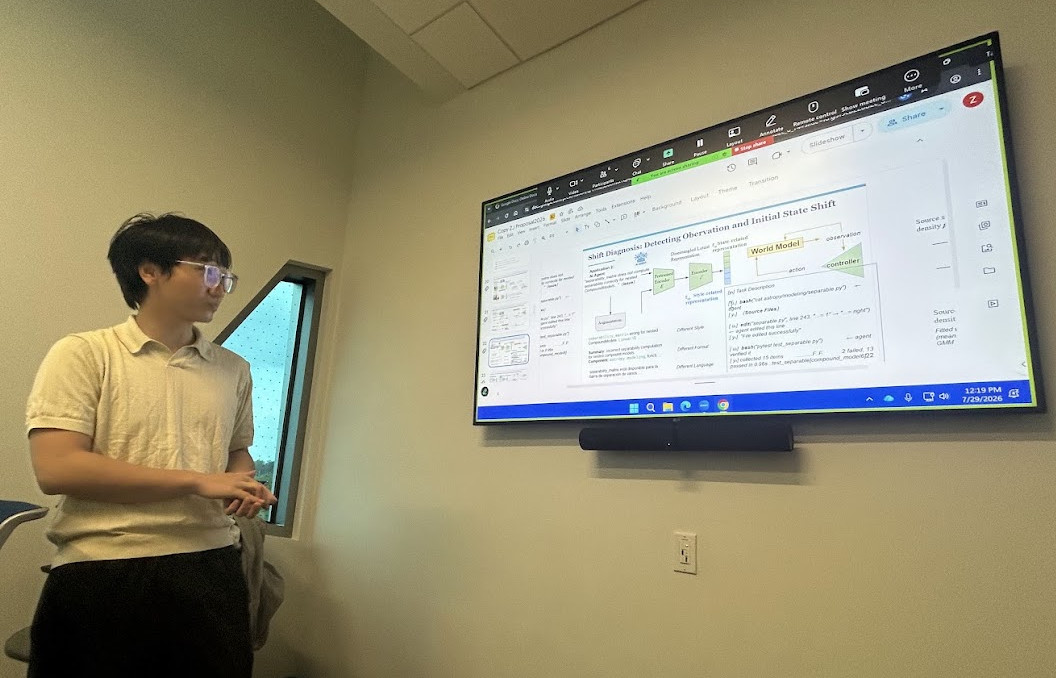
The proposed thesis, “Chance Prediction under Distribution Shift: Diagnosis, Calibration, and Guarantees for Visual Autonomy and Language Agents”, outlines a vision for detecting, adapting, and calibrating confidence under 4 types of shifts: observation, dynamics, initial state, and controller. If you are interested in the broader perspective on Zhenjiang’s recent work, check out this article by…
-

Zhenjiang and Ani present temporal confidence at ACL’26
—
Ani (who also volunteered) and Zhenjiang traveled to the Association for Computational Linguistics (ACL) conference in San Diego to present our work on using temporal signatures in language model logics to calibrate their correctness confidence. It was an exciting contribution and an exciting trip!