
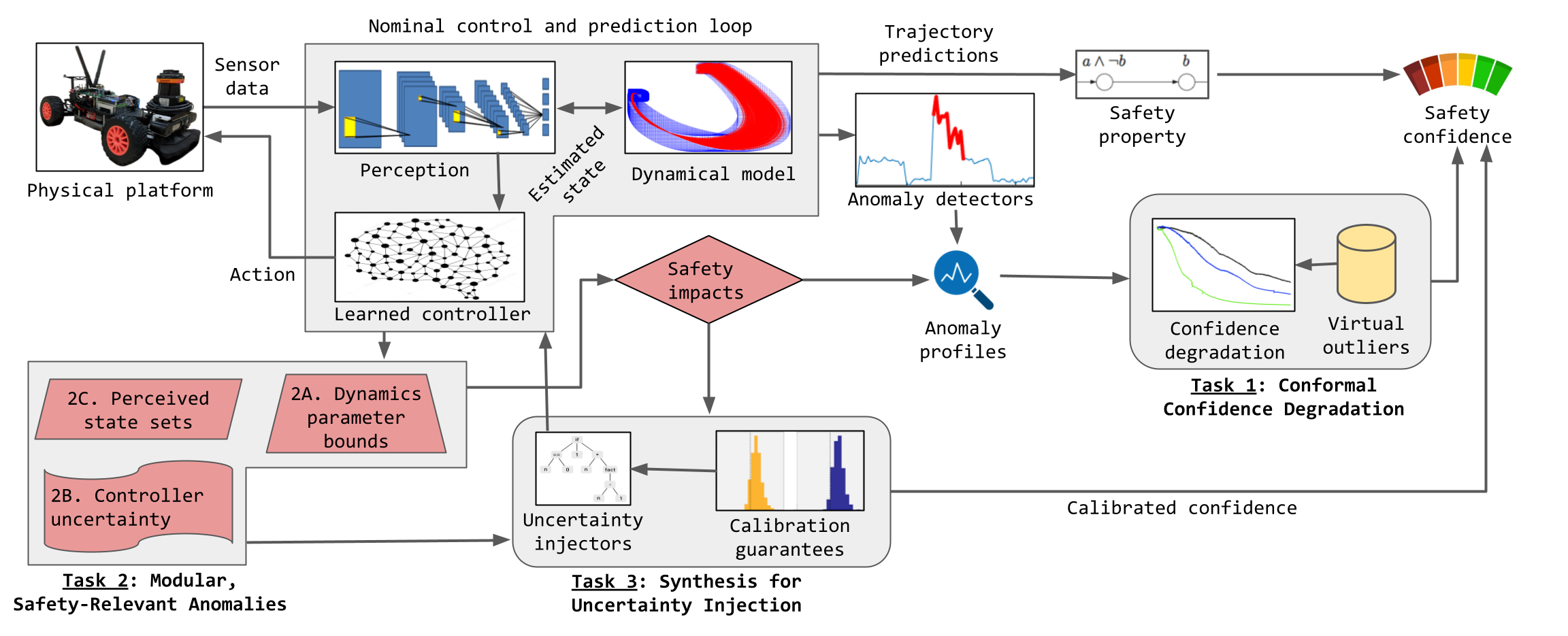
The last decade has seen a flourishing of detection capabilities for various anomalies and out-of-distribution samples. However, the question of what an autonomous system should do after it detects an anomaly is incredibly challenging and seems to be nowhere near a satisfying answer.
A reasonable step after detecting an anomaly is to figure out, in as much detail as possible, how much it affects the operation of the system: (a) How much are the sensing, perception, planning, control, or the environment affected? (b) How much are systemic properties, like safety, affected?
This new NSF CPS project will develop a framework called Methodology for Anomalous Safety Confidence (MASC). This framework will adjust (on the fly) the system’s confidence in its own safety/correctness based on the anomalies that it is detecting. Looking forward to the exciting research ahead!
Links:
- NSF award page
- UF press release
- Confidence composition research that inspired this project